




Benefits of balance: why is it important?

Did you know that doing activities that improve your balance is just as important for your health as other types of exercise? Having good balance helps us in ways you might not even think about day to day. Maintaining good balance is especially important in later life for preventing falls.
Here, I’ll explain why balance is important for fitness and health, throughout your life.
Benefits of good balance
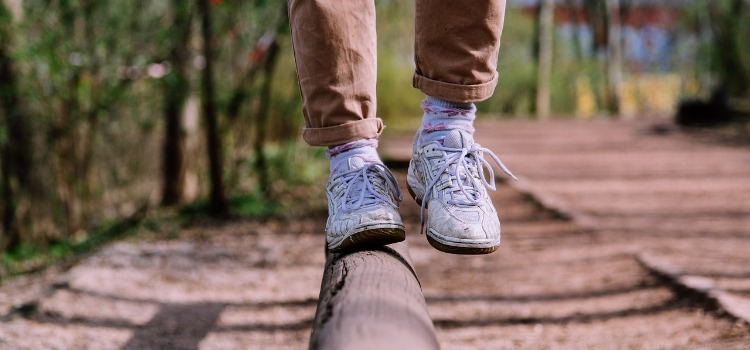
Balance means being able to stay upright and steady, whether you’re still or moving. We all know that physical activity, in any form, is good for our general health. But being able to balance – along with muscle and bone strength – supports the physical activities we do. Whether it’s getting dressed in the morning, taking the dog for a walk or running a marathon, you need to be able to balance.
How does age affect balance?
As we age, our ability to balance gradually declines. This can happen more quickly if you don’t keep active. As you get older, poor balance can also increase your risk of injuries caused by falls. And the older you get, the more likely falls will lead to serious injury and disability.
Having poor balance also acts as a marker for other health problems. These include problems with memory and thinking skills. And some studies have associated not being able to perform simple balance tests with shorter life expectancy.
The good news is it’s never too late to make a change. Evidence shows that doing some form of balance training – even later in life – can improve balance and reduce your risk of falls. Guidelines in the UK recommend that older adults (aged 65 years and older) should do balance activities at least two days a week. This should be alongside activities for muscle strength and flexibility, and aerobic exercise.
Balance throughout life
Balance isn’t just something to think about when you’re older. Balance activities can help to improve your overall physical ability at any age. If you’re an athlete, balance exercises may help to improve your performance and prevent injury. This is why balance exercises are routinely incorporated into training programmes for athletes.
Doing exercises to improve balance can help slow the natural decline in muscle and bone strength that starts around middle-age. There are also some key times in life when it can be particularly helpful to work on your balance. These include:
- pregnancy
- menopause
- developing or being diagnosed with a disease, which means you reduce your activity
- retirement
- becoming a carer
- after being in hospital
Improving balance at these points in your life may help to lower your risk of getting illnesses and injuries.
How do I improve my balance?
Certain sports and activities are particularly good for balance. Examples include:
- ball games, like cricket
- racquet sports, like tennis
- resistance training, including lifting weights
- aerobics or circuit training
- Nordic walking (a walking technique that uses poles to work your upper body)
- running
- cycling
- dancing
- yoga
- Tai Chi
Taking part in these activities may help with other elements of your physical fitness too. This includes improving muscle strength, bone health, and aerobic capacity.
Balance exercises
Exercises that focus just on balance are also a good way to improve your balance, and may help to prevent falls. Below, are some quick and easy examples that you can do at home. These can be safer and more practical for older people and those unable to do other forms of exercise. But they may also be useful for anyone wanting to incorporate balance training into their everyday life.
- One-legged stand. Stand on one leg, raising your other leg, for up to 10 seconds.
- Sit-to-stand. Stand up from a seated position and repeat up to five times in a row. Start using one hand to push off if you need to, progressing to no hands when you’re ready.
- Heel/toe raises. Using a chair or table for support, slowly raise your heels off the floor so you’re standing on your toes. Repeat the exercise raising your toes, so that you stand on your heels. As you progress, try extending how long you hold the raise for. You can also try taking some steps on your toes (toe walking) or heels (heel walking).
- Sideways walking. Stand with your feet together, and slowly step sideways. Then move your other foot to join it. Try performing 10 steps in each direction.
- Heel-to-toe walking (tandem walking). Walk with one foot placed directly in front of the other, so the toes of one foot touch the heel of the other. Use a wall or cabinet for support while you build confidence.
It’s always a good idea to start slow, and use support such as a sturdy chair, table or a wall to begin with. You can reduce this as your balance and confidence improves. And if you have health problems or have previously had a fall, ask your doctor or physiotherapist for advice first.
If you’re younger or want to try more challenging balance exercises, you could make some of the exercises harder by trying the following.
- Perfom the one-legged stand for a longer period of time, such as 30 seconds. You could also try closing your eyes or using an uneven surface such as a cushion or balance foam pad.
- When doing sideways or heel-to-toe walking, try turning your head as you step.
- Do something that distracts you a little while you do a balance exercise, such as juggling or counting backwards from 100 in intervals of 7.
-
Sources Sources
- Muscle and bone strengthening and balance activities for general health benefits in adults and older adults. Summary of a rapid evidence review for the UK Chief Medical Officers’ update of the physical activity guidelines. Public Health England. gov.uk, published July 2018
- Physical activity guidelines: UK Chief Medical Officers' report. GOV.UK. gov.uk, published September 2019
- World Health Organization 2020 guidelines on physical activity and sedentary behaviour. World Health Organization. who.int, published November 2020
- CG, Laukkanen JA, et al. Successful 10-second one-legged stance performance predicts survival in middle-aged and older individuals. Br J Sports Med 2022;56(17):975-980. doi: 10.1136/bjsports-2021-105360
- Howe TE, Rochester L, Neil F, et al. Exercise for improving balance in older people. Cochrane Database Syst Rev 2011;(11):CD004963. doi: 10.1002/14651858.CD004963.pub3
- Skelton DA, Mavroeidi A. How do muscle and bone strengthening and balance activities (MBSBA) vary across the life course, and are there particular ages where MBSBA are most important? J Frailty Sarcopenia Falls 2018;3(2):74-84. doi: 10.22540/JFSF-03-074
- Falls – assessment. Complications. NICE Clinical Knowledge Summaries. cks.nice.org.uk, last revised June 2025
- McLaughlin EC, El-Kotob R, Chaput JP, et al. Balance and functional training and health in adults: an overview of systematic reviews. Appl Physiol Nutr Metab. 2020 Oct;45(10 Suppl. 2):S180-S196. doi: 10.1139/apnm-2020-0279
- Brachman A, Kamieniarz A, Michalska J, et al. Balance training programs in athletes - a systematic review. J Hum Kinet 2017;58:45-64. doi: 10.1515/hukin-2017-0088
- Zhou J, Liu B, Xu JF, et al. Home-based strength and balance exercises for fall prevention among older individuals of advanced age: a randomized controlled single-blind study. Ann Med. 2025;57(1):2459818. doi: 10.1080/07853890.2025.2459818
- Campbell AJ, Robertson MC, Gardner MM, et al. Randomised controlled trial of a general practice programme of home based exercise to prevent falls in elderly women. BMJ 1997;315(7115):1065-1069. doi: 10.1136/bmj.315.7115.1065
- Tiedemann A, Sturnieks DL, Burton E, et al. Exercise and Sports Science Australia updated position statement on exercise for preventing falls in older people living in the community. J Sci Med Sport. 2025 Feb;28(2):87-94. doi: 10.1016/j.jsams.2024.09.003
- Helping older people stay active at home. Chartered Society of Physiotherapy. csp.org.uk, last reviewed April 2020
About our health information
At Bupa we produce a wealth of free health information for you and your family. This is because we believe that trustworthy information is essential in helping you make better decisions about your health and wellbeing.
Our information has been awarded the PIF TICK for trustworthy health information. It also follows the principles of the The Information Standard.

More exercise and fitness articles


Did you find our advice helpful?
We’d love to hear what you think. Our short survey takes just a few minutes to complete and helps us to keep improving our healthy lifestyle articles.
Legal disclaimer
This information was published by Bupa's Health Content Team and is based on reputable sources of medical evidence. It has been reviewed by appropriate medical or clinical professionals and deemed accurate on the date of review. Photos are only for illustrative purposes and do not reflect every presentation of a condition.
Any information about a treatment or procedure is generic, and does not necessarily describe that treatment or procedure as delivered by Bupa or its associated providers.
The information contained on this page and in any third party websites referred to on this page is not intended nor implied to be a substitute for professional medical advice nor is it intended to be for medical diagnosis or treatment. Third party websites are not owned or controlled by Bupa and any individual may be able to access and post messages on them. Bupa is not responsible for the content or availability of these third party websites. We do not accept advertising on this page.
